



Glaciers are the most important reservoir of fresh water on Earth - about three quarters of fresh water reserves are stored in glacial ice around the planet. At the poles, large ice sheets covering Antarctica and Greenland contain enough water that, if they melted, would significantly raise global sea levels, causing widespread flooding in coastal areas. As global temperatures rapidly rise due to carbon dioxide emissions, we are losing many mountain glaciers, and there is a real risk of losing significant volumes of ice in polar regions.
To better understand how climate change will affect mountain glaciers and polar ice sheets, Cardiff University in Wales has developed new equipment called Cryoegg.
It includes a KELLER 20D pressure sensor, a reliable sensor for measuring water pressure, and the initial research has yielded impressive results.
Cryoegg is designed to help improve research and obtain more specific information about the exact flow of liquid water inside and beneath glaciers and ice sheets in the future. The research results are expected to suggest new ways to protect glaciers for future generations.
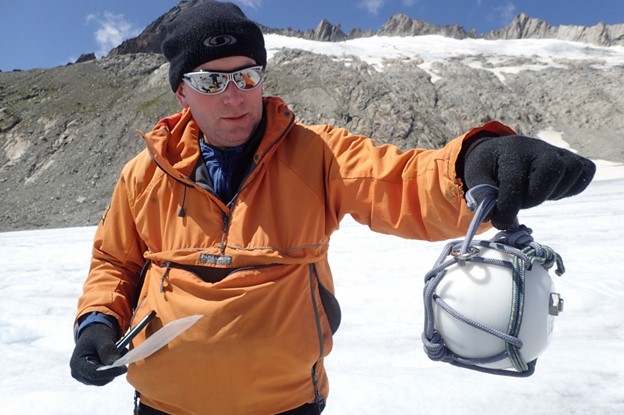
Mike Prior-Jones with Cryoegg for initial tests in Switzerland
The Cryosphere and Climate Change
The term "cryosphere" is used by scientists to denote all sources of frozen water on the planet. Here on Earth, the cryosphere also has a very significant impact on the climate system, as ice reflects a large amount of sunlight and heat back into space due to its high reflectivity. This effect is called the "albedo effect" and is responsible for the indirect cooling of our planet.
The persistently cold polar regions are also part of the global climate system - heat flows in the atmosphere and oceans determine weather and ocean circulation. For example, the Gulf Stream waters carry thermal energy from the Gulf of Mexico across the Atlantic Ocean to Norway, creating a mild climate in Europe.
However, since the beginning of the industrial era, greenhouse gas emissions have steadily increased, unfortunately leading to a rise in the baseline temperature of our planet. This means that our glaciers and poles are melting more and more each year, which has already led to a number of ecological and social consequences for our ecosystem. But it is not only the flora and fauna of our world that are under threat. We are also increasingly facing environmental disasters that increasingly affect our human existence. Looking further ahead, the melting of our glaciers could lead to even more serious problems, such as a global shortage of drinking water. Therefore, studying and protecting our glaciers and poles is crucial for our current and future life on Earth.
How Glaciers Work
Glaciers are not just solid ice.
If you walk on a glacier in summer, you often see small streams or rivers flowing on its icy surface. This is meltwater. If you follow one of these streams, it is quite likely that at some point it will disappear into a hole and continue its path underground. These holes are called "moulins", which translates from French as "mill", because they resemble fast-flowing water on a traditional water mill. Water disappears into the moulin and flows inside and beneath the glacier until it emerges at the glacier's end - either into the valley below or into the sea. Since we cannot see under the glacier, it is very difficult to understand how these water flows behave and how they affect glacier movement. Studies have shown that on mountain glaciers, water pressure increases in spring, lubricating the glacier and causing it to flow faster. Later, in summer and autumn, water carves channels under the ice, reducing pressure and slowing the glacier's movement again. Researchers study these moulins not only to gain a deeper understanding of the hidden channels of our mountain glaciers. More importantly, they seek better ways to study and understand how large polar regions and their underground channels work in places like Greenland.
Moulins are very dangerous. Filled with icy, fast-flowing water, they are subject to strong currents. For this reason, glaciers cannot be studied by divers. In research conducted so far, "subglacial probes" have been used to study glacier flow. Subglacial probes contain various sensors and are specially designed for glacier research.
Until now, scientists often drilled holes either mechanically or using a hot water drill. Then the probe is lowered into the borehole at the end of a cable. The cable supplies power to the sensor, and the sensor sends the data it records to a computer on the surface. Glacier movement causes borehole deformation, stretching the cable until it breaks. Therefore, the lifespan of modern subglacial probes is limited to just a few weeks.
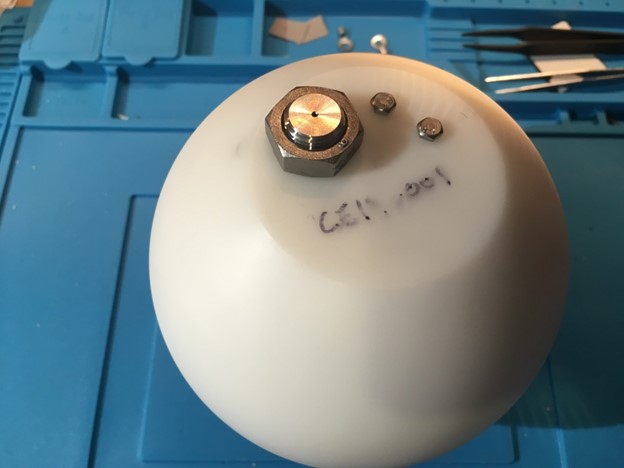
"KELLER pressure sensors have the reliability and durability needed to withstand even the harshest environmental conditions. The digital I2C interface also allowed us to easily integrate them into our electrical circuit." Mike Prior-Jones
Development with Additional Benefits: Cryoegg
Glaciologist Liz Bagshaw and engineer Mike Prior-Jones from the School of Earth and Environmental Sciences at Cardiff University in Wales have developed a new innovative form of subglacial probe: Cryoegg.
Cryoegg is a wireless spherical device containing a battery, sensors, and a radio transmitter. Its nearly spherical shape allows it to easily and smoothly glide through water channels inside glaciers. Therefore, the likelihood of it getting stuck is very low. Since Cryoegg is wireless, it can simply be lowered into a borehole.
Three parameters - pressure, temperature, and electrical conductivity - are measured using sensors built into Cryoegg. The pressure sensor is a KELLER 20D (250 bar) pressure transducer. It is equipped with a vacuum-sealed membrane and interfaces with the microcontroller via a digital I2C interface. The sensor transmits a 16-bit pressure value to the microcontroller but uses only half of the available range. The rest is used to indicate pressure slightly exceeding the calibrated range. This means the smallest reported pressure interval is 7.6 mbar. During practical field tests, the KELLER sensor was even able to detect water pressure changes with an accuracy of up to 0.1 bar. Separate, independent sensors are installed to measure temperature and electrical conductivity.
Field Tests
Field tests of Cryoegg were conducted on the Swiss Rhone Glacier in 2019. The team attached Cryoegg to a rope and lowered it into a moulin for testing. As soon as Cryoegg reached the bottom of the moulin, the water pressure it measured with the KELLER 20D sensor appeared on the monitor. Since the pressure steadily dropped to zero over the course of an hour, the team concluded that the stored water was draining from the moulin.
Ice is also very transparent to radio waves, so glaciologists have long used radar to see through it. Another field test was conducted in a borehole of the East Greenland Ice Core Project. It showed that Cryoegg can transmit data through more than 1.3 km of ice and that the sensors can operate at temperatures as low as -30 °C.
Have questions or need advice on selecting equipment for your production? Contact the specialists at "Izmerkon" — we will help find the optimal solution for your tasks.
_80x0_e6f.jpg "Pressure Transmitter Series 23SX-H2")
1)_80x0_e6f.jpg "Happy Defender of the Fatherland Day!")
_80x0_c25.jpeg "Radar Level Meter IZMERKON RL 37")