
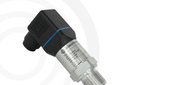





 Pressure sensors and pressure transducers are made from corrosion-resistant titanium.
Titanium, a hard silvery-gray metal, is a natural component of many minerals, especially ilmenite and rutile. Titanium is found more often in sand or soil than in hard rocks. Titanium is also contained in minerals such as perovskite, titanite, anatase, and brookite.
In 1795, German chemist Martin Heinrich Klaproth studied red sands brought from Hungary and discovered an oxide of an unknown metal in them. After examination, he was so impressed by the properties of the discovered element that he named it titanium, after the Greek gods. The most famous Titan is Atlas, who was sentenced by Zeus to carry the world on his shoulders.
For some time, Keller AG für Druckmesstechnik has offered to use titanium in its products for use in the most aggressive environments, as this metal has many advantages when used in especially critical conditions.
Titanium is used as a substitute for steel in aviation and space industries, mainly due to its lighter weight. Titanium is chemically and biologically neutral, which is especially valuable in medicine and surgery. This property arises due to the presence of oxide on the metal surface. Unlike high-quality steels, which are usually used in manufacturing, parts made of titanium will not be corroded even by salty or chlorinated water. That is why titanium is more often chosen for measuring technological processes in wastewater, which may be contaminated with unknown corrosive substances. Titanium's resistance allows hydrostatic measurements to be performed effectively both in hard water and other aggressive environments.
The appearance of the Keller pressure sensor with a diameter of 9mm, made of titanium, caused a sensation. If the same sensor were made of steel, the maximum operating temperature would not exceed 60°C. Higher temperatures cause greater deformation of the steel diaphragm, leading to irreversible bending. Unlike steel, the titanium diaphragm does not deform at temperatures up to 120°C, making titanium diaphragms more stable than steel ones. This is due to the elasticity coefficient, which is half as much for titanium as for steel.
At Keller Company, titanium is increasingly used to manufacture high-quality sensors that best meet the requirements for measurement stability.
_80x0_e6f.jpg "Pressure Transmitter Series 23SX-H2")
1)_80x0_e6f.jpg "Happy Defender of the Fatherland Day!")
_80x0_c25.jpeg "Radar Level Meter IZMERKON RL 37")


