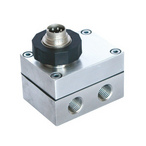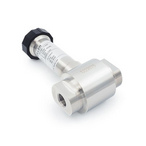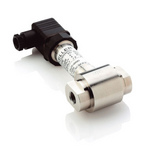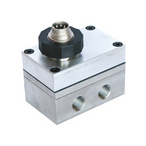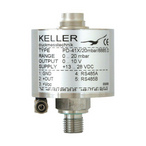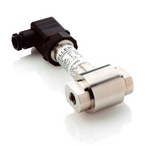



Speaking about the entire range of products manufactured by the Swiss factory KELLER AG, it is impossible not to separately highlight sensors that measure differential pressure, or as they are also called, difference sensors, or pressure drop sensors.
Differential Air Pressure Sensor
The need to use such sensors arises from the necessity to obtain differential pressure values when performing a very wide range of tasks. The most common example of using differential pressure values is the measurement and control of liquid or gas flow. The flow measurement principle is based on the Venturi effect and was known even in the times of the Roman Empire. The Venturi effect consists of a drop in the pressure of a liquid or gas when the flow passes through a narrowed section of a pipe. In the narrow part of the pipe, the flow velocity is higher, and the pressure is lower than in the section of the pipe with a larger diameter, resulting in a difference in the height of the liquid columns (delta h); most of this pressure drop is due to the change in flow velocity and can be calculated using Bernoulli's equation.

 This effect is achieved by changing the cross-section (configuration) of the pipe with special devices such as various diaphragms (a disk with a through hole inserted into the flow), Venturi flow meters, which narrow the liquid flow for measurement, and others.
And here comes the turn of differential pressure sensors, which actually measure the pressure difference simultaneously at two points – before the narrowing and at the narrowing itself. KELLER AG offers far more than just one option of such sensors! Various series, ranges, accuracy classes and protection levels, operating principles, Ex-applications, and output signals. But more on them later.
Differential Pressure Sensor
There are many other tasks that require measuring and controlling differential pressures. Let’s recall some of them: achieving low temperatures during slow gas flow under a constant pressure drop through a throttle (porous partition); in aviation applications in air pressure receivers to determine speed and flight altitude; for non-destructive testing during leak detection; for assessing the tightness of clean rooms; for checking the operability of fire suppression systems; for evaluating the energy efficiency of buildings, ventilation systems, pneumatic and hydraulic systems, and many others. Another widely demanded application of differential sensors is measuring the liquid level in pressurized tanks when it is impossible to measure the level by other means (for example, in boilers). In this case, the differential pressure sensor measures the pressures in the upper (unfilled) and lower parts of the tank and outputs the pressure difference value. When the liquid level changes, the pressure difference changes as well. The product of the pressure difference value and the liquid density (a known quantity) will indicate the liquid level in the tank.
Differential Pressure Sensor KELLER
Now, actually about the KELLER differential pressure sensors. There are four series: PD-23, PD-33X, PD-39X, and PD-41X. I immediately note that all sensors have a Type Approval Certificate and a Permit for use for Ex versions. Each of these series has its advantages depending on the specifics of the required measurements.
For example, the PD41X sensor is good for measuring small differential ranges (from 5 mbar) while providing high measurement accuracy, which is required for laboratory research and various tests, both for our domestic customers (e.g., Zhukovsky Central Aerohydrodynamic Institute and others) and foreign ones (e.g., Ferrari Group).

The PD39X sensors are good for measuring very large differential pressures with high accuracy (0.05% FS) because they use two KELLER absolute pressure sensors combined with common electronics and a microprocessor, making the sensor maximally resistant to overloads from one of the measured media. It should be noted that, for large quantities, such a dual sensor with electronics (without housing) can be supplied as an OEM solution for specific customer production tasks.

PD-23 is a high-precision sensor (0.2% FS) without a digital interface, which can provide measurements at frequencies up to 10 kHz (with an output signal of 0…10 V). It uses a two-sided KELLER series 10 sensor, which has proven itself well in various applications. In this sensor, as in the PD33X sensor, pressure acts on the sensor from both sides through process connection holes.

The PD33X sensor is a high-precision (0.05% FSO) sensor with a digital interface, versatile in its application. It is designed similarly to the PD-23 and uses a KELLER series 10 sensor. This sensor is especially good for measuring differentials not exceeding 5% of the FSO. At the same time, the pressure in the static line can be up to 200 bar, and optionally up to 600 bar. Like other sensors with a digital interface, it outputs both pressure and temperature values, which are taken into account in the thermal compensation algorithms. The obtained values are conveniently monitored and processed using KELLER software.

So, as we have been able to see, KELLER differential pressure sensors, fully meeting customer needs, provide accurate and stable measurements of the required parameters when solving a wide range of tasks. Specialists at LLC "Measurement and Control," if necessary, together with the manufacturer, are always ready to consult and help you select the KELLER differential pressure sensor that best suits your needs.
_80x0_e6f.jpg "Pressure Transmitter Series 23SX-H2")
1)_80x0_e6f.jpg "Happy Defender of the Fatherland Day!")
_80x0_c25.jpeg "Radar Level Meter IZMERKON RL 37")