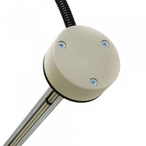





Capacitive Level Sensor

These are level meters that measure the electrical capacitance of a capacitive transducer (formed by plates or rods inserted into the liquid) and convert these measurements into the liquid level.
There are different designs of capacitive level meters that allow measuring the capacitance of electrically conductive and non-conductive liquids (electrically conductive liquids have a specific resistance less than 106 Ohm*m). When working with electrically conductive liquids, one of the plate or rod electrodes is insulated, while for non-conductive liquids both remain uninsulated.
Operating Principle of the Capacitive Level Meter
The capacitive level meter consists of two main elements: a capacitive sensor in the form of a rod or cable of cylindrical or flat shape and a secondary converter. The core of the device is a sensitive electric capacitor that accurately detects all changes in the dielectric permittivity of the medium. When in contact with the liquid, the capacitance of the capacitor is determined, which corresponds to the liquid level in the container, and then the obtained values are converted into an output signal that is transmitted to external equipment for monitoring.
Capacitive Level Sensor
The entire operating principle of such level meters is based on the fact that liquids and the gas space above them have different electrical properties. The sensitive elements immersed in the liquid determine the capacitance, while the second electrodes, remaining "outside," also take measurements, and based on this information, conclusions are drawn about the height of the liquid column.
Regarding the electrode system, it may vary depending on the model. In most cases, these are metal flat plates or hollow cylinders.
Applications of Capacitive Liquid Level Meters
Capacitive level meters provide continuous measurement of liquid levels. Devices of this type are suitable for use in various industrial sectors, including:
- Food industry: production of alcoholic beverages, sauces, drinks;
- Chemical industry: manufacture of varnishes, paints, liquid building materials, household chemicals;
- Water supply and sewage systems;
- Water extraction and packaging enterprises, including mineral water;
- Housing and communal services and agriculture;
- Oil refining, transportation with fuel tanks;
- Pharmaceutical companies.
Purpose of Capacitive Liquid Level Meters
Capacitive type level measurement devices can be used for measurements in tanks, storage facilities, pipes, and fuel tanks. They allow determining the current liquid level or tracking continuous level changes. There are also models capable of measuring in deep containers and wells or suitable for non-contact monitoring. In conjunction with additional sensors, such devices can transmit information to external equipment or monitor that the controlled liquid level remains stable.
Advantages of Capacitive Level Meters for Liquids
Capacitive level sensors for liquids differ from other types of level meters by the following advantages:
- Can measure in containers with different types of liquids, differing not only in composition but also in physical properties (temperature, density, degree of electrical conductivity);
- Provide fast response and high sensitivity to changes;
- Allowed for use with aggressive, hazardous liquids;
- Can operate even in a vacuum, meaning a wide range of liquid pressure in the container will not hinder measurements;
- No moving parts in the design, ensuring reliability, safety, and durability of operation.
However, sensitivity adjustment must be made for each new type of product. Additionally, these devices are not suitable for viscous, crystallizing, and explosive liquids (they are sensitive to deposits on the probe).
How to Determine the Capacitance of the Capacitive Level Meter Transducer?
The capacitance of the transducer, which depends on the level, is calculated by the formula
Cpr = Ci + C1C2/(C1 + C2), where:
- C1 – capacitance of the capacitor with electrodes on the surface of the electrode and electrically conductive liquid;
- C2 – capacitance of the capacitor with electrodes on the surface of the liquid (located at the same place as electrode C1) and on the surface of the container (reservoir or tank);
- Ci – capacitance of the pass-through insulator.
It is always taken into account that as the liquid height increases, C1 and C2 increase because the electrode area increases.
Wiring Diagram of the Capacitive Level Meter
The capacitive level sensor for fuel or stationary fuel tanks can be connected via digital or analog schemes using an isolated CAN bus and controller. A two-wire connection scheme is also used, allowing continuous monitoring of the liquid level. Additionally, some models can be installed using a pipe fitting or cable probe.
Since capacitive level meters measure the capacitance of the capacitor, and the product being measured serves as the insulating dielectric, for accurate operation, the devices can only be installed in containers with metal walls, and the wall where the mounting is performed must be strictly parallel to the probe.
After connection, a test start is performed, and calibration is carried out on an absolutely empty and fully filled container.
In the company «Izmerkon» they offer capacitive fuel level sensors with a complete description and connection instructions (schemes are provided depending on the interface).
| Fuel level sensor with CAN interface Rod length: 800 mm / 1600 mm Sensitivity: > 2 units per mm, usually 15 units per mm Digital integration filters: Adjustable time constant and integration coefficient, output signal change rate 15...240 mm/min |
 |
_80x0_e6f.jpg "Pressure Transmitter Series 23SX-H2")
1)_80x0_e6f.jpg "Happy Defender of the Fatherland Day!")
_80x0_c25.jpeg "Radar Level Meter IZMERKON RL 37")