






.jpeg)
Pressure sensor – is a device designed to convert physical pressure into an electrical signal that can be measured and analyzed. Depending on the manufacturer or region, such devices may be called pressure sensors, transducers, transmitters, or measuring modules.
Sensitive element – the foundation of the pressure sensor
Sensitive element (silicon chip) – is a high-quality but «raw» base for the sensor. Its key feature is a «raw», uncompensated, and non-standardized signal that requires mandatory individual calibration and complex electronic processing to turn it into an accurate and reliable measuring instrument. Such an element cannot simply be connected to a system to obtain precise measurements. It requires mandatory subsequent signal processing.
The silicon chip contains the sensitive element itself – silicon and piezoresistors formed into a Wheatstone bridge circuit. Deformation of the chip under the action of the measured physical pressure leads to a change in the resistance of the resistors due to the piezoresistive effect of silicon, which is registered as an imbalance of the bridge. Silicon has good piezoresistive properties.
Piezoresistivity – change in resistance under deformation
It is especially important to emphasize that piezoresistivity is the key difference between silicon sensors and metallic strain gauges, where a purely geometric effect works. Silicon provides many times greater sensitivity due to the change in charge carrier mobility when the crystal lattice is deformed.
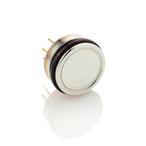
Sensor module – is a sealed metal housing inside which there is a silicon chip surrounded by an oil medium to transmit pressure to the silicon piezoresistive sensitive element (Wheatstone bridge). Unlike a finished sensor, the output signal of the element does not undergo compensation or standardization. It reflects the original characteristics of the Wheatstone measuring bridge, which may vary slightly even within a single production batch.
.jpeg)
Finished sensor – accuracy and reliability
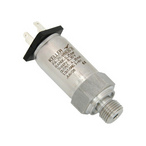
The key feature of manufacturing high-quality pressure transducers is the precise calibration of each device over a wide range of pressures and temperatures. The obtained data allows correcting the output signal using built-in electronics and adapting it to the specific requirements of the customer.
For example, the widely used 4–20 mA analog signal was previously adjusted manually using potentiometers (resistors). Today, this process is automated and performed using software, which guarantees high accuracy and repeatability of results.
.jpeg)
Sensor module and sensor mounting assembly: what is the difference?
The technical documentation uses the term “piezoresistive isolated pressure sensor.” This means that the sensitive chip is hermetically protected by a diaphragm and metal housing, isolating it from the measured medium.
Sensor mounting assembly (sensor assembly) – is a combination of the sensor and the connection unit, usually joined by welding. Thanks to the thread, hexagon, and sealing surfaces, the sensor mounting assembly is easier to install. The sensitive element requires a more careful approach to installation but provides more flexibility in design.
Both options are passive elements, as they do not contain electronics for signal processing.
.jpg)
Chip-in-Oil (CiO) technology – an innovative approach
In the C series and D series, the “chip in oil” technology is used, where all electronics are placed directly next to the chip inside an oil-filled housing. This eliminates the need for external components, making the design compact and resistant to moisture, vibrations, and shocks.
.jpg)
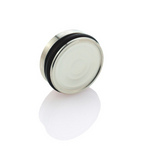
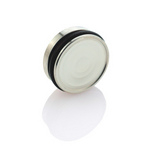
The C series is easily distinguished by the three-contact glass junction, while the D series is equipped with a digital I2C interface, making it ideal for integration into microcontroller systems. Despite their external similarity to passive elements, these sensors have full functionality.
.jpeg)
Custom solutions for any task
Izmerkon offers not only standard products but also solutions tailored to specific requirements. For example, if a client needs the performance of a pressure sensor series 33X, but installation space is limited, we can offer a sensor mounting assembly with open electronics. This requires additional installation effort but ensures a certain compactness and uniqueness of the solution.
.jpeg)
Key features of pressure sensors
- The sensitive element of the pressure sensor outputs a raw, unprocessed signal without amplification or standardization. In contrast, the pressure transducer includes additional electronics that correct the signal characteristics and convert it into a standardized output format.
- The C and D series lines are the most compact solutions, where the electronics are integrated directly into the sensitive element.
- In addition to standard models, specialized solutions are also available. We offer a wide range of combinations of sensitive elements, sensor modules, mounting assemblies with integrated sensors, OEM pressure transducers (with ADC board), and housed pressure transducers, allowing the creation of products fully meeting the customer's technical requirements.
To choose the right pressure transducers, contact our specialists.
_80x0_e6f.jpg "Pressure Transmitter Series 23SX-H2")
1)_80x0_e6f.jpg "Happy Defender of the Fatherland Day!")
_80x0_c25.jpeg "Radar Level Meter IZMERKON RL 37")