





FPT Motorenforschung AG is based in the Swiss city of Arbon and develops engines intended for vehicles and mechanisms in the Powertrain segment of CNH Industrial. About 220 employees work at the site to create new FTP products for commercial vehicles, construction machinery, and agricultural machines, as well as for use in industrial and marine applications. The engines are tested on more than 30 test benches. To measure their efficiency, FPT Motorenforschung uses tools such as M5 series pressure transducers from KELLER AG – the Swiss specialist in pressure sensors. The engines developed and tested at the plant meet the strictest quality requirements in terms of materials, emissions, and efficiency. This means that when researching engines on test benches, all variables that affect how well they perform must be taken into account. Thus, precise measuring equipment is required that provides reliable readings even under special conditions that can be detected even inside the engine.
The design of the M5 sensor incorporates the requirements of technical research. FPT Motorenforschung’s work is mainly focused on reducing exhaust emissions and achieving high power, low fuel consumption, long service life, and maximum reliability. The engine’s efficiency largely depends on how unobstructed the airflow into the combustion chamber and exhaust gases is. The pressure here will be below 10 bar. The main priority is to obtain extremely accurate and highly dynamic measurements using absolute pressure sensors. KELLER AG developed its M5 series to meet these specific engine testing requirements, and some of these devices are used in various locations on the engine during testing. For reliable analysis of conditions and pressure losses, it is important to take measurements as close as possible to individual cylinders at the intake. The changing geometry of the intake manifold presents an additional challenge, as this means each cylinder is supplied with a different amount of air, which should be avoided as much as possible. On the outlet side, gaseous combustion products in individual cylinders can also cause undesirable interactions between pressure surges or pulses. Pressure sensors measure these processes locally on the intake and exhaust sides with a high level of accuracy. When testing engines, it is important that sensors are not sensitive to mechanical noise, as sounds and vibrations from the engine cannot be correlated with the measurements. This application can also lead to compensation currents of up to 40 A generated by the engine battery – these must not affect the sensor. These requirements were fully met when the M5 sensor was developed. Other characteristics of the pressure sensor also give it an advantage in this particular application area: no connecting wires are needed, while there are also no connectors between the sensor and the electronic system. This eliminates any additional contact resistances and sources of faults. The cable gland is sealed (IP67) to minimize external impacts on the cable. Most of the electronic system is installed externally, allowing it to be located in a noise-free zone.
M5 Series – Ultra-fast Miniature Pressure Transducers

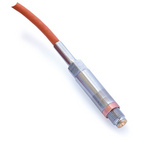
M5 HB series pressure sensors provide extremely fast and accurate measurements with an accuracy of 0.1% FSO over a temperature range up to 180°C. The pressure connection with fine M5 threading is designed for static and dynamic measurements, such as pressure pulses. Their miniature size makes these sensors ideal for local measurements. The main attributes of the sensor are its very small size and good ventilation. It uses backside technology without a transmission medium, which also helps minimize measurement signal attenuation. No sealants, adhesives, or capillaries are needed. To prevent any unnecessary impact on flow conditions, the process connection should be as short as possible and, from a handling perspective, easy to install even in narrow pipes. The sensor is very lightweight and capable of withstanding rapid acceleration.
The M5 series is available with amplifying and compensating electronics as well as without it. The main priority of the KELLER AG team when developing the electronic system was signal transmission accuracy up to the limit frequency of 100 kHz. M5HB pressure transducers (i.e., with an electronics unit) were optimized according to the technical specifications of FPT Motorenforschung AG and have been in use for more than three years.
Wide Range of Potential Applications in Engine Research
FPT Motorenforschung uses M5 sensors with electronic systems on all its test benches. The company performs measurements in components such as oil, fuel, and water pumps, injector lines, intercoolers, heat exchangers, and intake and exhaust channels. Recording pressure conditions allows detecting any fluctuations, peaks, or other unusual pressure phenomena. Engineers can then use these values as a basis for redesigning, further optimizing components and ECU (control unit) parameters. The obtained data facilitate extrapolation of dynamic conditions inside engines. For example, a pressure loss of 1 Pa at a volumetric flow of 1 m3/s — typical values for intake air volumes for large internal combustion engines — results in a power loss of 1 W. In practice, this means that a pressure drop of 50 mbar leads to a flow loss of up to 5 kW. Therefore, this value should be as low as possible to make the engine more efficient.
M5 sensors can also be used in return pipes (in injectors). Due to their design, injectors generate backflow through leakage and cooling. Pressure conditions in these pipes are also measured and optimized, with a pressure range from 1 to 5 bar. Oil pressure is another important factor in engine efficiency. While in low-speed engines it is usually too low, at high speeds it becomes too high. Regarding oil pressure measurement, it was especially important to find a sensor that was small enough. This is because smaller sensors have less impact on actual flow conditions. Additionally, there is often very little space for installation, meaning a standard sensor would not fit here.
M5 Pressure Sensor – Huge Potential for Engine Test Benches

One advantage is the fact that after testing is completed, open sensors can be sealed with a simple M5 threaded sleeve, as if nothing has changed. This means that any changes in the system will not distort the results of other tests. We are pleased that in the M5 sensor we found a reliable measuring instrument that can be used in a wide range of applications on our test benches. Over the years, we have had very constructive cooperation with KELLER AG. Moreover, offering a good price-performance ratio, they are a reliable and qualified manufacturer when we have technical issues. With production based in Switzerland, KELLER’s quality is as you would expect.
FPT Motorenforschung AG is one of seven research centers of FPT Industrial, a brand of the CNH industrial group engaged in the design, production, and sale of powertrains. FPT Motorenforschung AG is among the most important and innovative projects in the CNH Industrial transmission segment, focusing on further improving existing and developing fundamentally new technologies. FPT Motorenforschung has been designing and producing engines to the highest quality standards in Arbon since 1982. Besides engines, the company also develops its own testing technology. When choosing a pressure measurement solution, FPT sought short supply channels and good service alongside high product quality and compliance with technical specifications. The company already had many years of positive experience working with KELLER AG and found a partner whose products, like FPT, were also made in Switzerland: “We have been using the KELLER X series for our static and dynamic measurements for several years; our successful partnership reflects the advantages of having the user and developer close to each other and the high reliability shared by KELLER experts and products,” says Linsenmeyer.
KELLER AG has more than 40 years of experience in producing piezoresistive measurement technologies and has since developed custom pressure sensors for specialists of various purposes. An additional advantage is the company’s great flexibility, which allows finding an approach to any customer request. “Close working relationships with our customers are very important to us. They provide us with useful suggestions for improvements and valuable experience from actual observation of the applications used. Of course, this is especially pleasant if they are located nearby, like FPT Motorenforschung. This means our experts can see the situation up close and get involved if any technical problems arise,” explains Bernhard Fetterli, Head of Development at KELLER AG for Pressure Measurement Technology.
_80x0_e6f.jpg "Pressure Transmitter Series 23SX-H2")
1)_80x0_e6f.jpg "Happy Defender of the Fatherland Day!")
_80x0_c25.jpeg "Radar Level Meter IZMERKON RL 37")