





How do differential pressure sensors work and how do they differ from other types of sensors? What are the different principles of measuring differential pressure and what advantages do they offer? In this article, we will take a closer look at the world of differential pressure measurement and highlight two typical practical applications and related challenges.
It can be said that all KELLER pressure sensors measure pressure difference. However, relative and absolute pressure sensors have a specific reference point relative to which the pressure difference is measured. For absolute pressure, this reference point is an absolute vacuum. Relative pressure is measured relative to atmospheric pressure, also known as air pressure.
Unlike the pressure sensors mentioned above, a differential pressure sensor measures the difference between two variable pressure potentials, i.e., without a defined reference point. In practice, this means that the difference between any two process pressure values can be measured. Thanks to the additional process connection, differential pressure sensors can be easily distinguished from other pressure sensors.
More details about the similarities and differences between these three types of pressure measurement are explained in the article «Types of Pressure and Their Significance».
Construction of the cell for measuring pressure difference
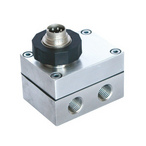
KELLER piezoresistive differential pressure sensors can be made in various versions. Features such as "wet" or "wet-wet" are found only in KELLER's range of differential pressure sensors and determine the compatibility of process connections with the medium.
The KELLER PD-33X series has a classic "wet-wet" connection, meaning the back of the sensor is also filled with oil. The measuring medium contacts the metal diaphragm, usually made of stainless steel, on both sides.

Construction of the PD-33X series
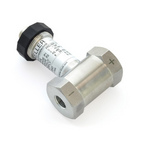
In the case of PRD-33X, this is not the case. The negative connection is connected directly to the back of the pressure sensor, so the measuring medium must not be aggressive or abrasive.

Construction of the PRD-33X series
The advantage of these two designs ("wet" and "wet-wet") lies in the very high resolution of differential pressure. It can be measured using a microchip designed for this pressure range.
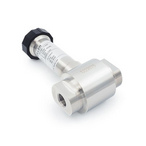
Alternatively, two pressure values can be determined using two absolute pressure sensors (PD-39X), and the differential pressure calculated electronically. This configuration is recommended especially for high pressures where one-sided pressure exposure cannot be excluded.

Construction of the PD-39X series
Typical applications of differential pressure sensors
Flow measurement
Along with temperature, pressure, and force, flow measurement is another important parameter in industrial measurement technology and one of the foundations of process automation. There are several methods for measuring flow. One common method is measuring the pressure drop using an orifice plate. To understand the principle of flow measurement, a brief excursion into the underlying physics is necessary.
Bernoulli's equation
Swiss mathematician and physicist Daniel Bernoulli, together with his brother Johann, derived Bernoulli's equation in the 18th century. It states that for incompressible liquids or gases (fluids), the mass of the medium moving through a cross-section over a certain period of time does not depend on the diameter of the pipe or pipeline. Simply put, this means that if the diameter of the pipe decreases, the flow velocity increases, and if the diameter of the pipe increases, the flow velocity decreases. At the same time, the flow velocity always remains constant. This phenomenon can also be observed in a morning shower. Depending on the showerhead setting, the water may seem more piercing or resemble a pleasant light summer rain. This effect is created by the different number of open nozzles through which the same amount of water is distributed. The use of an orifice plate, which is nothing more than an artificial narrowing, creates a pressure difference both upstream and downstream of the orifice plate. Using a mathematical formula, the volumetric flow rate can be calculated based on this pressure difference.

Q: Volumetric flow rate [m3/s]
α: Discharge coefficient
A: Cross-sectional area of the orifice plate [m2]
ρ: Density of the liquid in [kg/m3]
Δp = p1 - p2: Pressure difference in [bar]

Orifice plate
Level measurement in liquefied gas tanks
Pressure differential sensors are also used to measure the level in liquefied gas tanks. Gases such as oxygen, nitrogen, hydrogen, carbon dioxide, argon, and methane contained in natural gas are liquefied for transportation and storage. This reduces the volume by six hundred times. The volume of one liter of methane gas in liquid form can be reduced to 1.6 cm3. To maintain methane in a liquid state, a constant temperature below -162 °C is required. For this, the cryogenic tank must be perfectly thermally insulated. However, this is impossible to achieve completely, so the principle of evaporative cooling is used. A small amount of liquefied gas evaporates from time to time.
Thus, the temperature remains constant. The free space is filled with gas, which prevents conventional level measurement since the tank system is sealed. Due to the additional pressure acting on the liquefied methane, a pressure differential sensor is required to determine the level.
At -162 °C, the oil used in pressure transducers will not remain in liquid form, so the transducer is installed with a slight offset so that the measured gas reaches a temperature compatible with the transducer temperature.

Cryotank
Pressure peaks, thermal and temporal effects under special ISS conditions
Thanks to their outstanding characteristics and product quality, KELLER differential pressure sensors are also used on the International Space Station (ISS). To ensure measurement accuracy in the long term, several important factors must be considered in advance.
In pressure measurement technology, terms like "water hammer" or "pressure peak," also known as pressure surges or Zhukovsky jumps, are well known. They are caused by sudden opening or closing of valves and can rarely be completely eliminated. Such pressure surges are usually reduced thanks to the elasticity of the pressure pipeline. To prevent the pressure sensor from becoming a weak point, sufficient overload safety margin must be provided.
Rapid phase changes of liquefied gases back to gaseous state sometimes lead to ice formation on valves and pipes. Such temperature changes can cause minimal but measurable thermal hysteresis. If the pressure differential is measured by two absolute pressure sensors located in different places, as required, for example, when determining the fill level of a cryogenic tank, the sensors may age differently due to different installation positions and temperature conditions. To minimize this difference, both sensor elements are placed as close to each other as possible. As a result, both silicon chips are exposed to the same thermal influence and exhibit maximally similar behavior.
Piezoresistive sensors also exhibit long-term drift over time, even if it is practically negligible compared to other pressure measurement technologies. To eliminate this minimal error, the system is periodically vented to perform zero-point correction. This ensures very high accuracy of KELLER differential pressure sensors over a long period.
For more information about new devices and cooperation opportunities, you can contact IZMERKON by phone +7 (812) 309 56 05 or via the feedback form.
_80x0_e6f.jpg "Pressure Transmitter Series 23SX-H2")
1)_80x0_e6f.jpg "Happy Defender of the Fatherland Day!")
_80x0_c25.jpeg "Radar Level Meter IZMERKON RL 37")