




Absolute, Gauge (Excess) and Differential Pressures
With the advent of the steam technology era, there arose a need for devices to measure pressure. Bourdon tubes or bellows, in which mechanical deformation was transmitted to a pointer needle, were the first instruments for measuring pressure. They are still in use today.
Pressure metrology is the technology of converting pressure into an electrical signal.
For this purpose, a membrane design is usually used. In piezoresistive and thin-film technology, resistors are fixed on the membrane, which is subjected to pressure. Under the influence of pressure, the resistors change their characteristics (strain gauges). In capacitive technology, the membrane is a capacitor plate that changes its characteristics under pressure.
Using membrane technologies, we measure the difference in pressures applied to the two sides of the membrane. Based on the reference pressure, we use the following terms:
Absolute Pressure. Pressure in a closed, often evacuated, volume
Gauge Pressure. Pressure above atmospheric pressure (the reverse principle applies for vacuum pressure)
Differential Pressure. For measuring the difference (drop) between two pressures. Pressures are applied to both sides of the membrane

Piezoresistive Pressure Sensor. Silicon Cell.
The sensor consists of a silicon cell processed with special equipment, with strain resistors placed on it. This entire assembly is located on a silicon or glass substrate.
The resistance of the resistors is approximately 3.5 kOhm. Pressure increases the resistance of the radial resistors "r" and decreases the resistance of the resistors "t", transverse to the radius. This change in resistor resistance can reach at least 30%.
The resistors are connected as a Wheatstone bridge.
The output signal of the bridge is directly proportional to the pressure.

Main Methods of Signal Pickup from the Bridge
Two methods of signal pickup are used:
— Gold or aluminum wires are soldered to aluminum contacts on the microchip and to pins on the glass substrate base.
— TAB construction does not imply rigid fixing of the sensor on the substrate. The sensor simply floats in oil and is fixed using a flexible ribbon cable, through which the contacts are output to the pins on the base. This way, we avoid problems related to thermal expansion of the adhesive joint. This design also protects against sharp surges, preventing sensor damage from sudden reverse pressure(during a sudden pressure drop).
In the first case, the sensor must be fixed on the substrate.


Low Cost Sensors
LowCost sensors are devices in which the sensors are exposed to the environment without any protection.
Series 2, 4 and 5 are exactly such sensors.
In series 2 and 4, where the glass substrate with the silicon cell is placed in a plastic housing, with a connection for positive pressure (series 2); positive and negative pressure (for series 4).
In series 2TAB and 4TAB, the silicon sensor with the TAB board is located between two plastic welds with pressure connections.
In series 5, the silicon sensor is soldered to a brass pressure port. Contacts are made either from gold wires soldered to pins or via a TAB flexible ribbon cable.

Series 2: Pressure acts on the outer part of the microchip: exclusively for dry environments.
Series 4, Series 5: Pressure acts on the inner part of the microchip: also suitable for liquids.
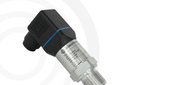
_80x0_e6f.jpg "Pressure Transmitter Series 23SX-H2")
1)_80x0_e6f.jpg "Happy Defender of the Fatherland Day!")
_80x0_c25.jpeg "Radar Level Meter IZMERKON RL 37")