



Whereas careful handling of "energy" as a resource was previously explained by cost-saving considerations, today ecological awareness is also growing. All this is also becoming mandatory due to legislative requirements and the level of technological development. In this article, you will learn how continuous filter monitoring has a decisive impact on system energy efficiency and helps comply with legal requirements.
Whether air filters in ventilation and air conditioning systems or oil filters in hydraulic circuits, in both cases increasing contamination of the filter element leads to an increase in pressure drop. To maintain a constant flow of the medium (air or oil), the fan or pump (respectively) must apply more power. Energy consumption increases as a result. Filter monitoring signals an increase in pressure drop on the contaminated filter element. Replacing the contaminated filter ensures the flow of the medium and thus prevents increased energy consumption of the fan or pump.
Legal basis
By adopting the Kyoto Protocol in 1997, the European Union committed to reducing CO2 emissions. To achieve this climate goal, the EuP (Energy using Products) directive was adopted in 2005. In 2009, it was renamed the ErP (Energy-related Products Directive) - also known as the Ecodesign Directive.
High resistance - high energy consumption
It is easy to understand that a contaminated filter element creates more resistance to the flow of the medium than a new, clean element. Physically, the pressure at the inlet (at the filter inlet) increases - which can be well monitored using a pressure measuring device, and the flow rate decreases. Since the required flow rate is set, more energy is needed to compensate for the resistance in the filter.
Energy and cost considerations
From an energy perspective, a slightly contaminated filter should be replaced immediately. But this contradicts the fact that replacement itself requires material and labor costs. In addition, replacement can only be carried out when there is no pressure or flow, meaning the machine or process must be stopped. Based on these considerations, it becomes clear that replacement after a certain period of use, as happens, for example, with annual car maintenance, is not an optimal solution.
Compromise: filter monitoring
A compromise solution is an acceptable level of contamination - that is, a set maximum differential pressure on the filter. Normal limit values of pressure drop (ΔP) on a hydraulic filter range from 1 to 5 bar. In ventilation systems, the limit values range from 50 to 5,000 Pa (from 0.5 to 50 mbar). Pressure drop monitoring allows savings on operating costs since filters are replaced only when the filter contamination level is close to the allowable limit. Another advantage is that thanks to continuous monitoring, filter replacement can be planned during the work process.
Filter monitoring in hydraulic circuits
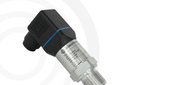
Return filters in hydraulic circuits are a special case. As the name suggests, they are located in the return line, directly before the oil flows back into the tank. Atmospheric pressure is present in the tank. This means that ambient pressure is also present at the filter outlet. This simplifies monitoring since the differential pressure sensor can take on the measurement task, which positively affects the cost of filter monitoring.
On the one hand, these pressure sensors are cheaper than differential pressure sensors. On the other hand, you save on the need to lay a pressure pipeline from the filter outlet to the low-pressure port of the ΔP sensor. Measuring oil temperature is very important for hydraulic circuits. It allows accounting for the high viscosity of hydraulic oil, which is still cold at startup, thus avoiding false alarms. Hydraulic oil temperature is necessary for controlling the oil radiator. It significantly affects the oil usage time.
Filter monitoring trends
From "preventive maintenance" to cloud solutions of the "Internet of Things" - data is in demand everywhere. This is clearly seen in the transition from traditional measuring instruments with optical displays to electrical sensors with analog or digital output signals.
When monitoring pressure filters, there is a trend to replace the differential pressure sensor with overpressure sensors before and after the filter. This allows obtaining both the system pressure and the pressure at the filter outlet, which a differential pressure sensor does not provide. The pressure drop, the difference between the two signals, is then calculated in electronic control, a computer, or in the cloud.
We will be happy to provide consultation on all your questions. Just fill out the form and our specialists will contact you shortly.
_80x0_e6f.jpg "Pressure Transmitter Series 23SX-H2")
1)_80x0_e6f.jpg "Happy Defender of the Fatherland Day!")
_80x0_c25.jpeg "Radar Level Meter IZMERKON RL 37")


