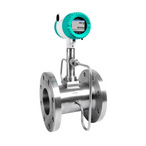





Compressed air is used in the production process at most factories and plants, but many do not realize that it is one of the most expensive types of energy resources, and the rational use of compressed air is one of the most important tools for energy saving. Most often, the user's attention is focused on the production of compressed air, that is, on compressors. Therefore, to save energy, new compressors, control systems, and heat utilization systems are usually installed. Measuring compressed air flow can significantly reduce energy costs.

Energy Costs of Compressor Units
When talking about the operating costs of compressor units, we are essentially talking about energy costs, as they account for 70% to 80% of the total cost of the compressor. Operating costs vary depending on the size of the compressor but always represent a significant amount. Even at small plants, it can range from 500,000 to 1 million rubles per year. This amount can be significantly reduced, even if compressors are regularly maintained and kept in fully operational condition. In the case of a 200 kW compressor operating in three shifts, the generation of insufficient compressed air can create excess energy costs of more than 1 million rubles.
Most savings are achieved by eliminating leaks and selecting the correct pipeline diameters to minimize pressure losses. Since monitoring of energy resources such as electricity, gas, or water is usually carried out, their costs can be easily estimated. Unlike compressed air leaks, water leaks are easily noticeable and can therefore be quickly detected and fixed. Compressed air leaks often remain unnoticed and continue to increase costs even during production downtime and weekends. It is also worth noting that compressors usually continue to operate during this time to maintain constant pressure in the system. In a system of compressed air that has grown over the years, the share of leaks can be from 25% to 35%.
Leaks that consume air 365 days a year exceed the compressed air consumption of any other equipment at the enterprise. To this, one can add the hidden costs of producing clean and dry compressed air. The cost of air produced by refrigerated and adsorption dryers is quite high. And this even more expensive air is also lost due to leaks.
Determining the Share of Compressed Air Leaks
With constantly rising energy prices, in order to remain competitive in the market, energy-saving measures must be implemented. Savings can only be achieved if the compressed air consumption of each device is known. However, often the user has no information about the share of leaks in the system. Below we explain how you can easily determine the scale of leaks at your enterprise.
Previously, a simple but inaccurate container method was often used to determine the share of leaks. Only a clock and a pressure gauge are needed to perform this measurement. It is also necessary to know the volume of the tank and the compressed air system used.
When conducting measurements, first it is necessary to bring the pressure in the empty tank connected to the system and the pneumatic system itself to the shut-off pressure. All devices consuming compressed air must be turned off at this time. After that, the compressor must be turned off – as a result, compressed air will stop being supplied to the system. Then it is necessary to measure the time required for the pressure to drop by 1 or 2 bars due to leaks.
Disadvantages of Leak Measurement by the Container Method
The above method requires a lot of time and is extremely inaccurate for the following reasons:
1. The volume of the pipeline cannot be measured accurately.
2. The accuracy of both pressure and time measurements must be taken into account.
3. During the pressure drop, the air cools, and for this reason, the flow value changes.
4. Real-time flow measurement with recording is impossible.
This method belongs to the so-called indirect measurement methods, as does the load and unload measurement method, in which current clamps are used to measure current consumption, after which, using technical information about the compressor, the obtained value is converted into a flow value.
These indirect methods are inaccurate and unsuitable for determining the scale of leaks at low measurement ranges.
Analysis of Compressed Air Leaks Using Modern Flow Measurement Instruments
A modern compressed air or leak flow measurement system must be capable of measuring actual consumption and detecting even the smallest leaks accurately and quickly.
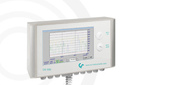
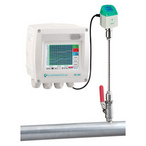
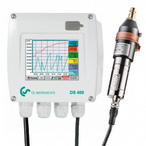
 Compressed air and gas metering system DS400
DS400 – A unique device with a 3.5-inch touchscreen and a save-to-print function. For 20 years, CS Instruments has been designing, manufacturing, and supplying compressed air and gas flow sensors with long-term stability. The easy-to-connect DS400 allows measurement of both current flow in m³/h or l/min and accumulated flow in m³.
The DS400 system uses a proven thermal anemometric measurement principle. At the core of the system is a flow meter that employs a new efficient sensitive element structure, characterized by a higher temperature at the same electrical connection values. Compared to other devices using the thermal anemometric measurement principle, the sensitive element of this flow meter has significantly less mass, resulting in a shorter response time. Moreover, no temperature or pressure compensation is required, allowing the user to operate the flow meter in environments with varying pressure and temperature without further compensation.
In addition to compressed air, the device can also measure oxygen, CO2, argon, natural gas, helium, etc.
The DS400 system comes with all necessary accessories for connection. Therefore, there is no need to study the manual in detail to connect the device.
Threshold exceedance indication can be acoustic or optical. Two signal relays are freely configurable. The alarm delay can be set for each of the two relays. This allows recording only long-term threshold exceedances. There is also the possibility to reset the alarm.
The intuitive 3.5-inch display with zoom function and save-to-print button is unique in this price range. The color display can show current flow values, peak values, and leak values. All values are saved in the data logger. The user can view flow graphs directly on the device without downloading data to a computer. This enables quick analysis of compressed air or other gas flow. Using a special button, screenshots can be saved as graphic files on the built-in memory card or exported to USB and then printed without any additional software.


The device is ideal for documenting measured values and graphs on-site. Color graphs can be saved in graphic format and sent by email or included in reports.
The built-in data logger allows saving information for several years. Recorded data can be exported via USB drive or Ethernet network and processed on a PC using the CS Soft Basic software.
Flow analysis is performed by pressing a single button. CS Soft Basic automatically generates daily, weekly, and monthly reports.
Advantages of DS400:
- 3.5-inch color touchscreen
- Zoom function for precise analysis of measured values
- Flow analysis with generation of daily/weekly/monthly reports
- Creation of color graphs with naming of each variable
- Mathematical calculation function allows, for example, summing flow from multiple devices into a total or calculating energy consumption in kWh/m³.
- Save-to-print: saving data in graphic format
- Data saving to USB drive and sending via email
- Ability to operate without software
- Two signal relays for threshold exceedance signaling
- Easily adjustable alarm delay
- With reset function
- Up to 4 recording channels: possibility to connect flow meters, dew point sensors, pressure, temperature, current meters, optional third-party sensors: Pt100/1000, 0/4..20 mA, 0-1/10 V
- Modbus interface, pulse input
- Built-in data logger with 2 GB memory
- Interfaces USB, Ethernet, RS485
- Web server
To select a compressed air metering system for your enterprise, please contact our technical specialists.
_80x0_e6f.jpg "Pressure Transmitter Series 23SX-H2")
1)_80x0_e6f.jpg "Happy Defender of the Fatherland Day!")
_80x0_c25.jpeg "Radar Level Meter IZMERKON RL 37")


-min_146x146_c23.jpg "Стрелка")
-min_146x146_c23.jpg "Стрелка")
-min_146x146_c23.jpg "Стрелка")
_146x146_c23.jpg "Стрелка")