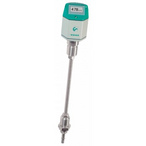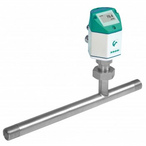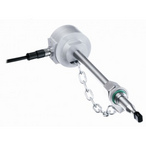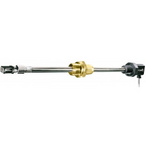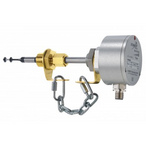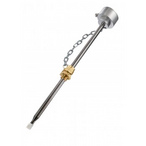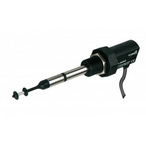
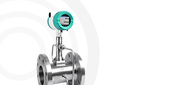

Thermal flowmeter — a flowmeter in which the effect of heat transfer from a heated body by the moving medium is used to measure the flow velocity of a liquid or gas, and which measures the flow of the substance passing through a given cross-section of the pipeline per unit time. If the device has an integrating device with a counter and is used for simultaneous measurement of the quantity of the substance, it is called a flowmeter with a counter.
Thermal flowmeters differ in design: by the heating method, the location of the heater (outside or inside the pipeline), and the nature of the functional dependence between the flow and the measured signal. The main heating method is electric ohmic heating. Inductive heating is rarely used. Sometimes heating with the help of an electromagnetic field and with the help of a liquid heat carrier is applied. By the method of thermal interaction with the flow, thermal flowmeters can be divided into calorimetric, thermoconvective, and thermoanemometric. With electric ohmic heating, in calorimetric flowmeters the heater is located inside, and in thermoconvective ones — outside the pipe. Sometimes individual flowmeters with external heating are called calorimetric flowmeters.
Calorimetric flowmeter with external heating:
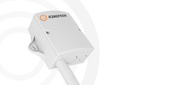
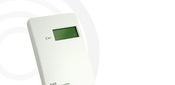
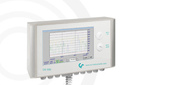
Calorimetric flowmeters are based on the dependence of the average mass temperature difference of the flow on the heating power. The sensitive element of CS Instruments flowmeters consists of two platinum resistive elements located inside the pipeline; the first element measures the gas temperature, the second maintains a constant temperature higher than the gas temperature, while the measured gas tends to cool it.

The flow and gas velocity are calculated based on the temperature difference and the current required to maintain the temperature on the second resistive element. The advantage of calorimetric and thermoconvective flowmeters is the constancy of the heat capacity of the measured substance when measuring mass flow.
You can learn more about our flowmeters here.
_80x0_e6f.jpg "Pressure Transmitter Series 23SX-H2")
1)_80x0_e6f.jpg "Happy Defender of the Fatherland Day!")
_80x0_c25.jpeg "Radar Level Meter IZMERKON RL 37")