



Piezo-resistive pressure sensors are distinguished by their sensitivity, which allows measuring even the slightest pressure changes. However, the materials used have a fairly high temperature dependence, which must then be compensated.
The behavior of the piezo-resistive pressure transducer changes according to temperature. While the temperature-related zero offset is self-evident and can be easily recognized and checked by an engineer, temperature changes in both sensitivity and linearity are less obvious and therefore often ignored.
The cause of zero offset is a combination of various factors:
- different resistance values on the silicon chip
- different temperature coefficients of individual resistors in the measuring bridge
- inhomogeneous silicon membrane coated with a layer of silicon oxide (changing expansion coefficients)
- mechanical stresses during the mounting of measuring cells on the carrier (chip, glass, glass passage)
- oil expansion related to the stiffness of steel membranes (which is why the volume of oil is minimized)
Depending on the sensor design and the pressure range itself, these individual factors have significant impact. What is important in practical terms is not what actually causes the thermal zero offset, but how well it can be compensated. Ideally, the response should be as linear as possible over the maximum possible temperature range.
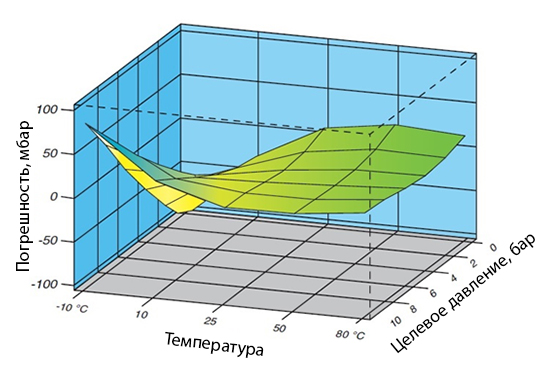
Best results with polynomial compensation
Linearity also shifts with temperature. This mathematical model precisely describes the full pressure and thermal characteristics of the transducer. However, to be able to apply this mathematical model, computer or digital compensation methods are required.
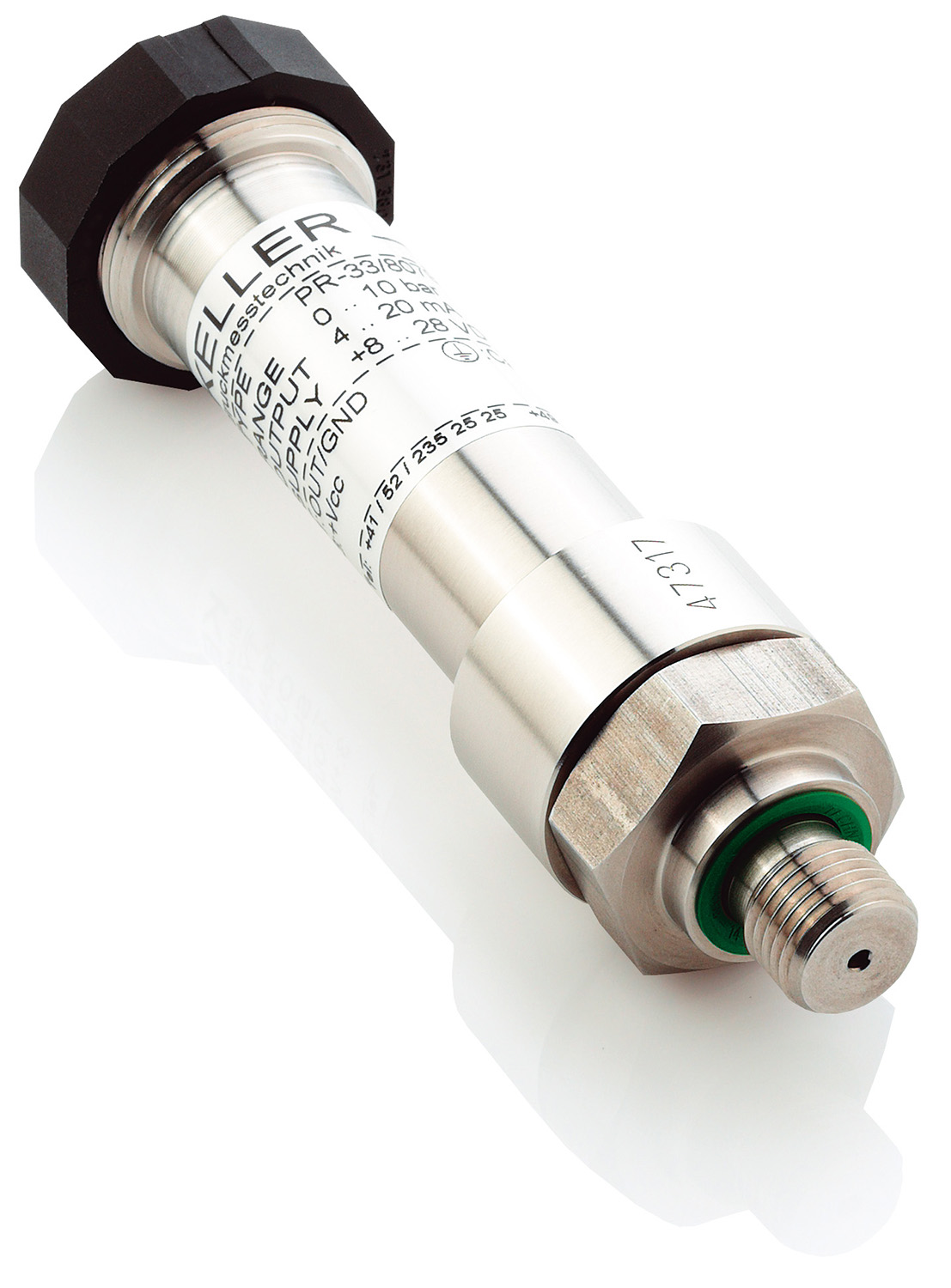 In Keller products, this is achieved through polynomial compensation. Piezo-resistive pressure sensors of the 33X series achieve, for example, an accuracy of 0.05% FS over a temperature range of -10 ... + 80°C. The 33X is a pressure transducer widely known and used due to its stability and low temperature hysteresis. Often during production or testing, the customer must be confident that the products or services they produce meet the highest requirements. Therefore, a high-precision pressure sensor must be chosen carefully.
This series of pressure transducers was developed for industrial applications where special requirements for measurement accuracy and stability are demanded. Measurement ranges from 0.1 to 2000 bar are suitable for both liquids and gases. These transducers use KELLER 10th series sensors, which have proven their reliability and superiority in millions of different applications worldwide. Each sensor undergoes calibration and testing across the entire range of measured pressures and operating temperatures.
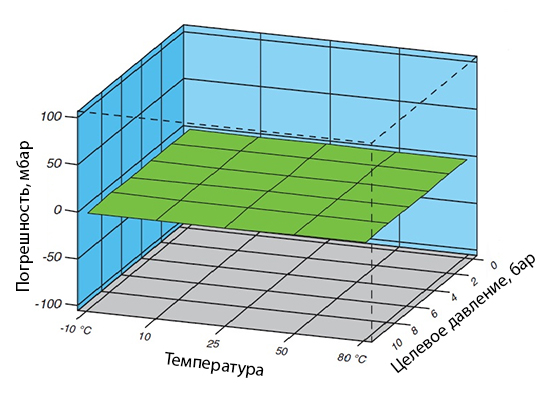
Most Keller pressure sensors are optimized as standard for operating temperatures from -10°C to 80°C – an excellent range for achieving accurate results in most applications. In some cases, however, the advantage lies in sensors being delivered pre-optimized for temperature conditions (e.g., from -40°C to 120°C) arising from any specific application. Thus, Keller specializes in providing pressure sensors specific to certain conditions and does so in the shortest possible time.
_80x0_e6f.jpg "Pressure Transmitter Series 23SX-H2")
1)_80x0_e6f.jpg "Happy Defender of the Fatherland Day!")
_80x0_c25.jpeg "Radar Level Meter IZMERKON RL 37")