

- Electromagnetic Flowmeters
- Ultrasonic Flowmeters
- Tachometric Flowmeters
- Coriolis Flowmeters
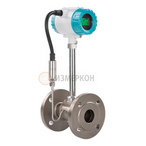
- Vortex Flowmeters
- Differential Pressure Flowmeters
Flowmeter

A flowmeter is a device for measuring the amount of working substance, liquid, or gas that has passed through a pipeline. Since compressible and incompressible substances have their own measurement specifics, devices in this segment differ in their operating principles. Each category is designed to operate in an environment with certain operational characteristics, has specific parameters, and possesses its own advantages and disadvantages.
Electromagnetic Flowmeters
These devices are based on Faraday's law (electromagnetic induction). An electromotive force is generated under the influence of water or another conductive liquid passing through a magnetic field. The liquid flows between the poles of a magnet, creating an EMF, and the device measures the voltage between two electrodes, thereby measuring the flow volume. This device operates with minimal errors provided it transports purified liquids and does not impede the flow.
Advantages of Electromagnetic Flowmeters
- There are no moving or stationary parts in the cross-section, which helps maintain the liquid transport speed.
- Measurements can be made over a wide dynamic range.
Disadvantages
- If the liquid contains magnetic and conductive sediments or contaminants, the device will operate with distortions.
Ultrasonic Flowmeters
This type of flowmeter is equipped with ultrasonic signal transmitters. The speed of the signal traveling from the transmitter to the receiver changes each time the liquid moves. If the ultrasonic signal travels in the direction of the flow, the time decreases; if against it, the time increases. The volumetric flow of the liquid is calculated based on the difference in signal travel time downstream and upstream. Typically, these devices come with an analog output and a microprocessor control unit, and all displayed data is shown on an LED display.
Advantages of Ultrasonic Flowmeters
- Resistance to vibrations and shocks.
- Durable and stable housing.
- Suitable for the oil refining industry and cooling systems.
- Measure the flow of water and liquids with physical properties similar to water.
- Operate within a medium dynamic measurement range.
- Can be installed on pipelines with large diameters.
Disadvantages
- Increased sensitivity to vibrations.
- Sensitivity to sediments that absorb or reflect ultrasound.
- Sensitivity to flow misalignment.
Tachometric Flowmeters
In tachometric flowmeters, the main measuring element is a impeller or turbine (arranged perpendicular or parallel to the flow, respectively). The rotation speed and the number of revolutions made in the flow are measured.
Advantages
- Suitable for measuring the flow of liquid, steam, and gas.
- Simple and inexpensive models.
- Easy to install on small-diameter pipelines and often used in household settings.
- Operate without a power source; no electrical connection required.
Disadvantages
- For large-diameter pipelines (i.e., in industrial metering), tachometric flowmeters are too expensive due to high metal consumption and are also too bulky.
- Create hydraulic resistance to the flow and, in the case of large diameters, can cause "blockage" or fail due to mechanical breakdowns.
- Low reliability for industrial measurements, small dynamic range.
- Insufficient measurement accuracy: results are affected by impurities and foreign objects in the flow.
- The service life is not high enough: suitable for household conditions, but not for industrial use.
Coriolis Flow Meters
The operating principle is based on the Coriolis effect: U-shaped tubes are subjected to oscillations during flow, and the vibrational oscillations, in turn, cause the substance to twist. The phase shift magnitude depends on the mass flow rate of the liquid or steam. The flow is measured considering the formed twisting angle. Most often, such flow meters are used for liquid media, including paints, varnishes, and liquid polymers.
Advantages
- Mass flow is measured directly.
- Deposits or contaminants dissolved in the liquid do not affect measurement results.
- There are no obstacles in the internal cross-section; the system operates stably.
- Suitable for measuring all types of liquids, regardless of their electrical conductivity.
Disadvantages
- High cost, complex technological components.
- Requires high-precision installation.
- Measurement accuracy may vary under strong vibrations.
Vortex Flow Meters
These devices measure the frequency of oscillations that occur in a gas or liquid flow when bypassing obstacles. The flow around the obstacles leads to vortex formation (hence the name of this type of device), and the magnitude of vortex changes allows calculating the flow rate.
Advantages
- Suitable for measuring the flow of gases, technical air.
- No moving parts in the design.
Disadvantages
- There are mechanical obstacles in the cross-section that hinder the movement of the medium.
- Measurement accuracy significantly decreases if the bluff body is contaminated.
- The device is sensitive to temperature changes.
- Vibrations affect the results.
- Measurements are possible within a small dynamic range.
Vortex flow meters measure the frequency of oscillations that arise in a liquid or gas flow when they bypass obstacles. When flowing around obstacles, vortices form, from which the devices get their name.
Differential Pressure Flow Meters
The operating principle of these devices is based on measuring the pressure drop that occurs when a liquid or gas flow passes through a narrowing device (orifice plate, nozzle). At this point, the flow velocity changes, and the pressure increases. Measurements at the obstacle point are made using a differential pressure sensor.
Advantages
- There are no moving parts in the device.
Disadvantages
- Measurements are possible within a small dynamic range.
- Any deposits on the narrowing device lead to significant errors.
- Mechanical obstacles in the cross-section reduce the reliability of the design.
These six options are considered the main types of flow meters for measuring volumes of liquids and gaseous media, air, and water.
Izmerkon company offers a wide selection of industrial air and compressed gas flow meters, including those with digital interfaces. You can choose a suitable model based on the description or by consulting with our managers. Our company from Saint Petersburg provides shipping of measuring instruments throughout Russia.
_80x0_e6f.jpg "Pressure Transmitter Series 23SX-H2")
1)_80x0_e6f.jpg "Happy Defender of the Fatherland Day!")
_80x0_c25.jpeg "Radar Level Meter IZMERKON RL 37")


_146x146_c23.jpg "Стрелка")