




The necessity of supplying carbon dioxide to the greenhouse is clearly demonstrated by the general formula of photosynthesis:
 6CO2 + 6H2O + light energy = C6H12O6 + 6O2↑
Here it is seen that glucose (the main organic substance, the energy source for plants) is formed from carbon dioxide and water with the participation of light energy. It turns out that CO2 serves as one of the most important building blocks in metabolic processes.
Sometimes you can hear the opinion that CO2 should not be supplied to the greenhouse. Some explain this by the fact that carbon dioxide is released as a product of decomposition and the result of the activity of soil microorganisms, while others argue that the greenhouse structure itself is not airtight, and the necessary substances come from atmospheric air. However, in practice, it turns out that these statements may only be true for private households where sterile artificial substrates are not used, and the greenhouses themselves are built with airtightness violations. In new agricultural complexes, it is quite possible that the carbon dioxide content inside the greenhouse is 4 times less than in the atmosphere, which leads to slowed plant growth.
Supplying CO2 to greenhouses: when and why it is necessary
Plants consist of 95% carbon in dry matter, and they draw it from the atmosphere. Each cubic meter of air contains 0.56 grams of carbon dioxide. But plants are capable of assimilating 4 times more. Under standard conditions, the concentration of CO2 is 0.03-0.04% of the total air volume. Agrochemists recommend increasing the carbon dioxide concentration to 0.1-0.15%, that is 3-5 times compared to atmospheric air. This is especially justified under conditions of enhanced diffuse lighting, when CO2 consumption increases many times. Accordingly, this will allow increasing the carbon dioxide concentration to 0.2-0.6%, which will significantly accelerate the photosynthesis process.

And this, in turn, reduces the ripening time of fruits by an average of 7-12 days. Yield also increases – according to statistics, in greenhouses where carbon dioxide is supplied additionally, it is 15-40% higher (depending on the type of crops). But it is important not to allow the CO2 concentration to exceed 0.6%, as in this case crop growth may slow down. Accordingly, it is necessary to know how to increase the carbon dioxide content in the greenhouse and what to do if elevated CO2 is detected. To be able to control these indicators at the right times, special sensors are installed.
Why is it important to control the amount of CO2 in greenhouses?
Carbon dioxide supply to the greenhouse can be carried out in three ways:
- Introduction of exhaust gases from the boiler room;
- Direct gasification by installing a plasma burner;
- Installation of a gas gun or direct supply of carbon dioxide from a cylinder.
This is how carbon dioxide can be obtained in the greenhouse. When supplying gas as a combustion by-product from boiler rooms, it must be pre-cooled. However, the question of the purity of the supplied gas mixture remains open: side products contained in it can negatively affect the temperature and humidity regimes inside the greenhouse. The mixture also contains carbon monoxide, which is dangerous not only for humans but also for plants.
Using cylinders with purified carbon dioxide (gas mixture purity – 99.8%, no harmful substances in the composition, according to GOST 8050-85) is considered safer. In this case, centralized carbon dioxide supply can be organized. The list of necessary equipment in this case also includes devices for measuring CO2 in the greenhouse – control and measuring equipment capable of maintaining the required carbon dioxide concentration and changing it if necessary (the value will differ for different crops).
Modern CO2 sensors
CO2 supply systems in greenhouses allow providing a gas mixture that actively participates in photosynthesis. Stable presence of CO2 at the required concentration creates prerequisites for early stable flowering and increases yield even better than the use of mineral fertilizers.
Control of CO2 content in the greenhouse air (i.e., the state and quality of the air environment) is ensured by special sensors. They are installed in various greenhouse farms, regardless of the variety of crops grown there.
Principle of operation of the devices
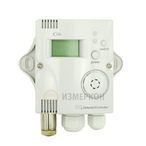
The CO2 regulator in the greenhouse is an electronic device with non-volatile memory, a relay that will trigger (turn on and off) at set values. The device can be integrated into a complex with industrial humidifiers and ventilation systems.
The carbon dioxide sensor in the greenhouse provides measurements of concentration in the range from 0 to 2000 ppm, and optionally up to 5000 ppm or 10000 ppm. The allowable temperature is up to 50 degrees, humidity up to 95%, with no condensation allowed.
The touch carbon dioxide sensor in the greenhouse operates on the following principle: the intensity of infrared radiation before and after absorption by carbon dioxide is measured, the amount of light passing through the optical filter and absorbed by carbon dioxide is measured. The device calculates the difference between the absorbed flux and the flux passing by the optical device.
Types of sensors
Carbon dioxide CO2 sensors in the greenhouse are produced as stationary (powered by the electrical network) and autonomous (with an independent power source) devices, designed for wall, floor, desktop mounting, or direct installation in the ventilation duct.
The devices are equipped with polycarbonate housings, characterized by high impact resistance and chemical durability.
Dispersive analyzers use single-wavelength radiation obtained by a monochromator. Models with non-dispersive infrared detection demonstrate high measurement stability (they provide accuracy regardless of the oxygen content in the air). Modern models operate using the NDIR method (non-dispersive IR spectroscopy). They are highly sensitive, have a long service life, require no complex adjustments, and come in a modern design. However, it should be noted that they are sensitive to dust and moisture. Therefore, it is necessary to choose models with a dust and moisture-proof IP65 housing and to select the installation location correctly.
How to choose sensors for a greenhouse?
All measuring instruments installed in greenhouses must correspond to the climate features (high humidity and increased content of pollutants in the air, including herbicides and fertilizers).
The main selection criteria are:
- High measurement accuracy, within 30ppm;
- Durable, functional housing with increased protection against moisture and dust;
- Presence of a relay;
- Convenient light and sound indication for quick monitoring and performance checking;
- Availability of an auto-calibration procedure compensating for the aging of the infrared source;
- Snap-on mounting flange on the housing for easy installation.
Choose professional sensors that allow controlling CO2 in the greenhouse. These carbon dioxide content meters help regulate gas supply and maintain agricultural technology. The catalog of Izmerkon company features high-precision carbon dioxide detectors and duct concentration CO2 converters. In greenhouses, this equipment allows controlling the gas supply generator and naturally increasing crop yields.
_80x0_e6f.jpg "Pressure Transmitter Series 23SX-H2")
1)_80x0_e6f.jpg "Happy Defender of the Fatherland Day!")
_80x0_c25.jpeg "Radar Level Meter IZMERKON RL 37")